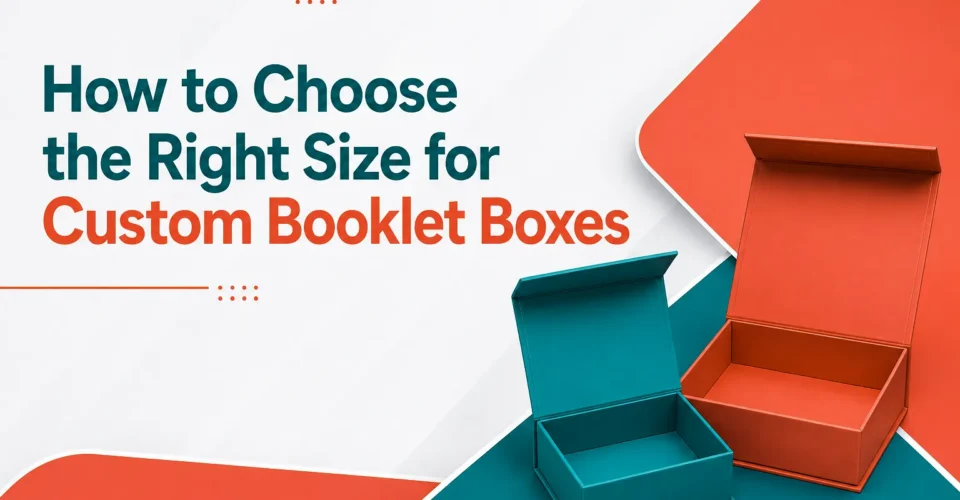
Choosing the right size of a booklet box is more important than choosing the right design. This is because the primary function of booklet boxes is to protect the cosmetics and other products inside. An ordinary design serves that purpose, but in appropriate dimensions may affect the product in many ways.
An appropriate booklet box dimension can protect the contents. It leaves some extra space for the box inserts, and packaging peanuts. It manages the shipping and manufacturing costs. Above all, creating a wonderful unboxing experience is another advantage of a right box dimension.
This Booklet Box Size Guide explains how to measure your products, choose between standard and custom sizes, select appropriate materials, and work with a packaging professional to develop packaging that fits your product and business requirements.
Why Booklet Box Dimensions Matter
What Are Booklet Boxes? A Complete Guide to Custom Booklet Box Packaging deeply delves into the characteristics of these boxes. So, here is some useful information about their dimensions.The dimensions of a box influence almost every stage of the packaging process. It must be right from the manufacturing and storage stage to shipping and user end.
Product Safety
A properly sized box prevents excessive movement during transportation. When there is too much empty space, products can shift, collide with the box walls, or become damaged during handling. On the other hand, a box with insufficient clearance can put pressure on the product and make packing difficult.
For fragile products such as glass cosmetic bottles or electronic accessories, the internal dimensions should account for cushioning, dividers, or molded inserts.
Shipping Efficiency
Packaging dimensions can affect shipping costs because carriers may calculate charges using both actual weight and dimensional or volumetric weight. Reducing unnecessary empty space can therefore help businesses make their shipping packaging more efficient.
For example, a promotional kit containing a notebook, pen, brochure, and small gift may technically fit inside a large box, but a compact custom box can reduce unused volume while keeping every item organized.
Storage
Your packaging also occupies warehouse space before it reaches customers. Hundreds or thousands of oversized boxes can consume valuable storage capacity.
Efficient packaging dimensions make it easier to stack, organize, and transport inventory.
Customer Satisfaction
Packaging is part of the product presentation. A box that opens cleanly and holds everything securely creates a more professional experience than packaging that looks oversized, crushed, or poorly fitted.
For premium brands, the box can also reinforce brand identity through structural design, printing, and finishing.
How to Measure Products Correctly Before Ordering
Before requesting a quotation or approving artwork, measure the actual packed product, not simply the product description supplied by the manufacturer.
The basic measurement sequence is:
Length × Width × Height
However, the final internal dimensions may need additional space for inserts, protective padding, closures, or multiple products.
Measure Length
Measure the longest horizontal dimension of the product from one end to the other.
If the product has an unusual shape, measure the maximum usable length rather than relying on the average dimensions.
For example, a cosmetic gift set containing a long serum bottle and applicator should be measured according to the complete arrangement inside the box.
Measure Width
Measure the product at its widest point.
Do not assume that a product’s front-facing dimensions represent its actual width. Handles, caps, protruding components, or accessories may extend beyond the main body.
For electronics, remember to include cables, adapters, controllers, or other components if they will be packaged in the same compartment.
Measure Height
Height becomes particularly important when products are placed vertically or when the box includes an insert.
Measure from the lowest point to the highest point of the complete product. If the product has a lid, cap, or other raised component, include it in the measurement.
For a bottle placed inside a presentation insert, for example, the required height is determined by the bottle plus the insert and any necessary clearance.
Leave Room for Inserts
Inserts change the amount of usable space inside a box.
A foam insert, cardboard divider, molded pulp tray, or paperboard insert may occupy several millimeters, or considerably more, depending on its construction.
Therefore, calculate the space required by the product and the insert rather than ordering a box based solely on product measurements.
Consider Protective Padding
Fragile products may require additional clearance for tissue paper, foam, corrugated pads, air cushions, or other protective materials.
The exact clearance depends on the product, material, packaging structure, and distribution environment. Instead of applying a universal measurement to every product, test the packed configuration with a physical sample.
This is especially important for products that will travel through parcel networks, where packages can experience repeated handling and movement.
Popular Size Chart for Booklet Boxes:
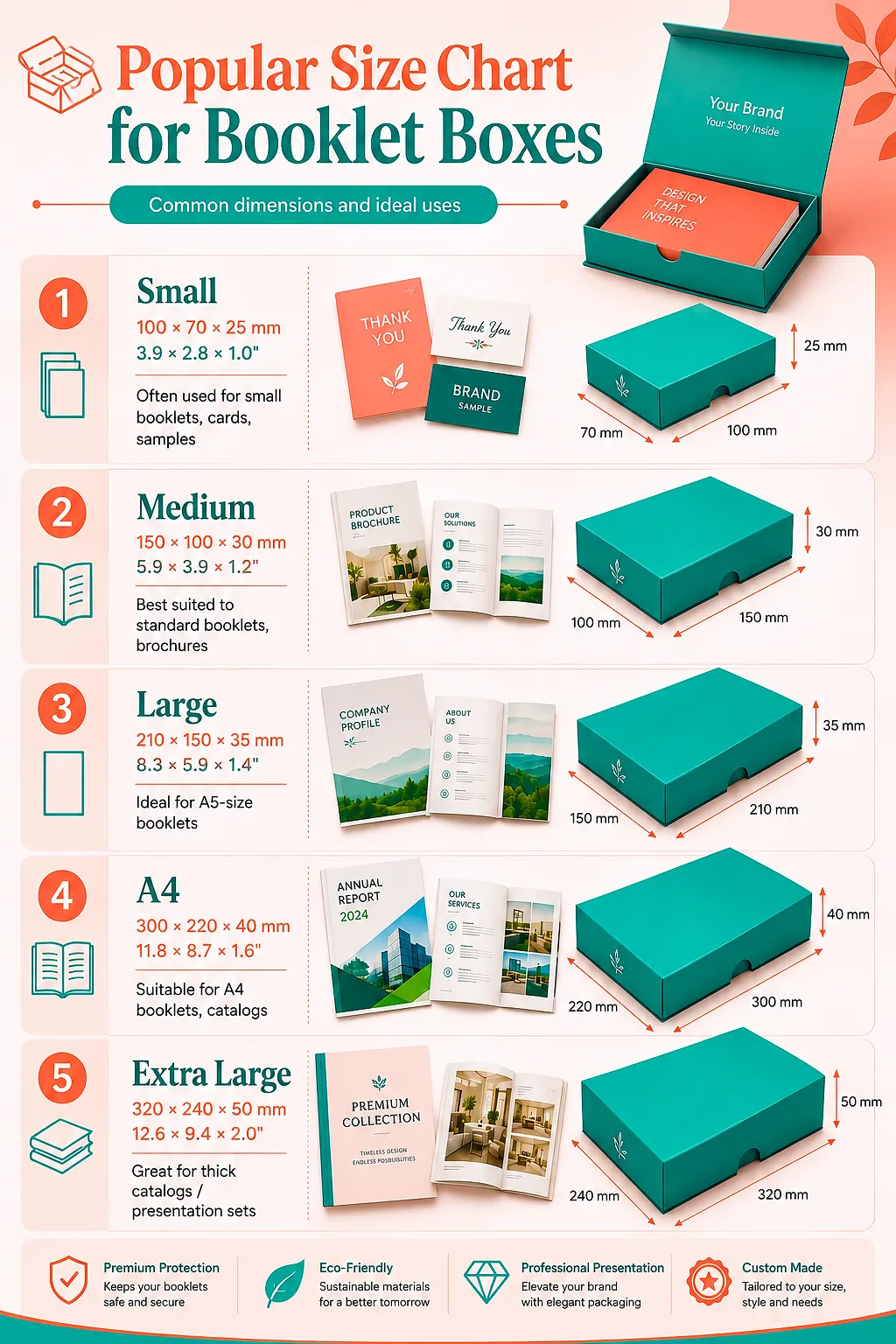
Small: 100 × 70 × 25 mm, 3.9 × 2.8 × 1.0″ often used for small booklets, cards, samples
Medium: 150 × 100 × 30 mm, 5.9 × 3.9 × 1.2″. They’re best suited to standard booklets, brochures
Large : 210 × 150 × 35 mm, 8.3 × 5.9 × 1.4″ for example A5-size booklets
A4: 300 × 220 × 40 mm, 11.8 × 8.7 × 1.6″ such as A4 booklets, catalogs
Extra Large: 320 × 240 × 50 mm 12.6 × 9.4 × 2.0″ like Thick catalogs / presentation sets
Standard vs Custom Booklet Box Sizes
There is no single universal size that works for every booklet-style package. Standard dimensions can be useful when your product closely matches an available format, while custom dimensions provide a more precise fit.
| Feature | Standard | Custom |
| Cost | Usually economical | May cost more depending on structure and quantity |
| Lead Time | Often faster | Requires design and production planning |
| Product Fit | Suitable for common product sizes | Designed around the actual product |
| Branding | Available but may have structural limitations | Greater structural and printing flexibility |
| Shipping | Efficient if the fit is good | Can minimize unnecessary volume |
| Best For | Simple, common-sized products | Specialized products, kits, and branded packaging |
Standard Booklet Box Sizes can work well for products with predictable dimensions and straightforward packaging requirements. They may also be practical when speed and cost are more important than achieving a precise fit.
Custom sizing is preferable when your product has an unusual shape, multiple components, protective inserts, or premium presentation requirements.
For example, a luxury gift containing a perfume bottle, greeting card, and accessory may benefit from a custom internal layout rather than being forced into an off-the-shelf box.
Factors That Affect Booklet Box Dimensions
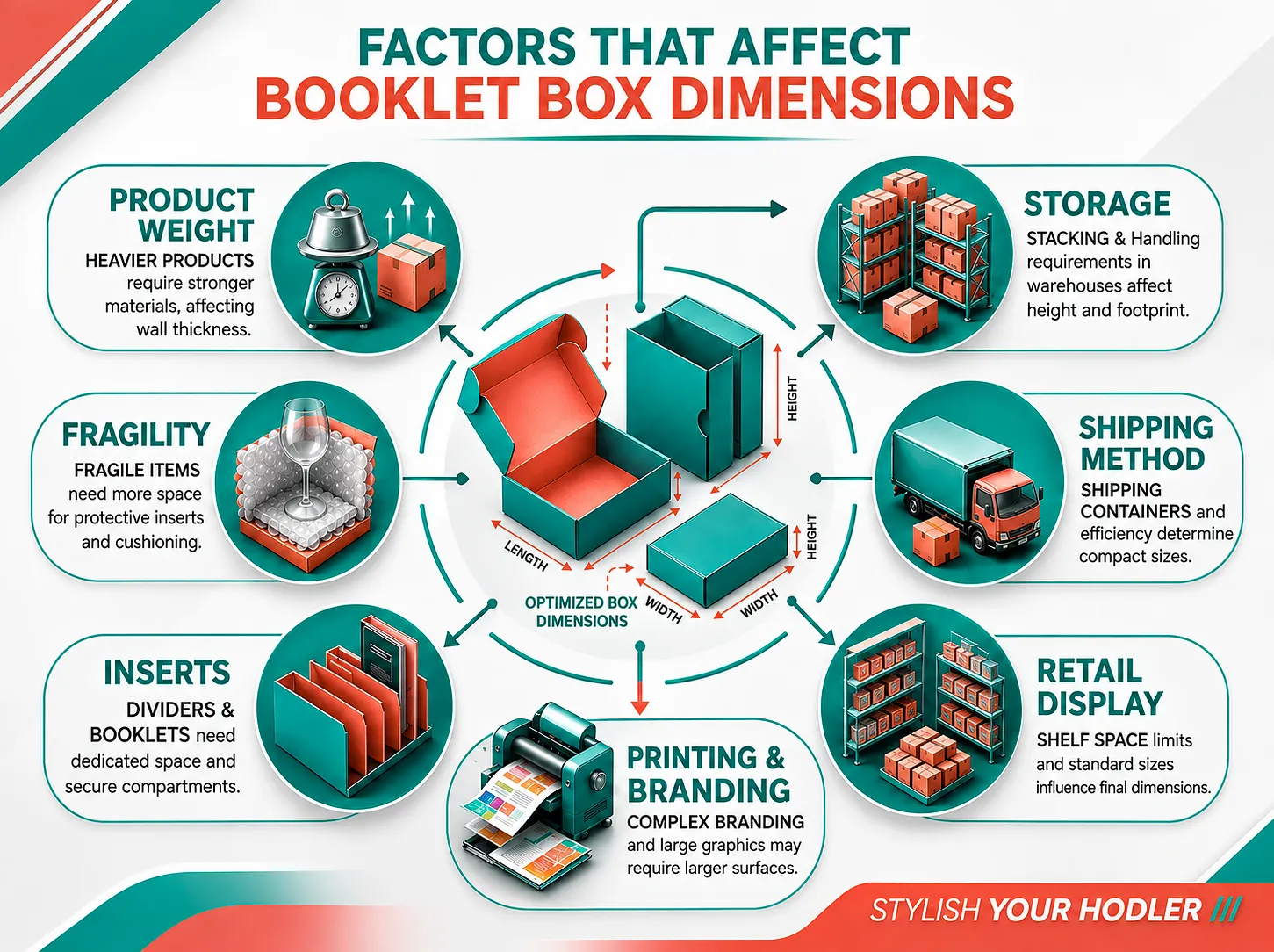
Product measurements are only the starting point. Several other factors influence the final custom booklet box dimensions.
Product Weight
A lightweight paper product can often use relatively light paperboard packaging. A heavier product may require a stronger board grade or a corrugated construction.
The dimensions also influence structural strength. A large box with a heavy product may require reinforcement to prevent flexing or crushing.
Fragility
Glass, ceramics, electronics, and other delicate products need more protection than durable items.
Fragile products may require partitions, cushioning, or a snug internal fit. The packaging should be tested with the intended shipping method rather than evaluated only by appearance.
Inserts
Inserts can improve product organization and presentation, but they also consume internal space.
A cosmetics kit with several bottles, for example, may need individual cavities to prevent the products from touching one another. The final box size should therefore be developed around the complete insert configuration.
Printing and Branding
The physical size of the box affects the available print area and the placement of design elements.
Offset printing and digital printing can be used for branded packaging, while finishes such as matte lamination, gloss lamination, foil stamping, embossing, and spot UV can add visual impact.
The important point is to finalize the structural dimensions before preparing the final artwork so that logos, text, patterns, and other design elements align correctly with the panels.
Retail Display
If the packaging will sit on a retail shelf, consider how much space it will occupy and how the product will face customers.
A box may need dimensions that balance product protection with shelf appeal. Excessively deep packaging can waste retail space, while packaging that is too compact may compromise presentation.
Shipping Method
A box designed for direct-to-consumer shipping may need different specifications from packaging intended only for retail display.
For e-commerce, consider the packed shipping dimensions, protective requirements, stacking, and dimensional weight. If the booklet box itself is a presentation package, it may also need an outer mailer or corrugated shipping carton.
Storage
Think beyond the individual box. Calculate how many flat or assembled boxes you will store and how they will be stacked.
This is especially important for Booklet Packaging Boxes ordered in large quantities.
Choosing the Right Material for Your Box Size
The relationship between material, dimensions, and product weight is important. A large box made from lightweight stock may not perform like a smaller box made from a stronger material.
Kraft
Kraft packaging is popular for brands seeking a natural appearance and sustainability-focused presentation. It works particularly well for lightweight products, promotional items, food-related products, and brands that want an understated aesthetic.
Cardboard
Paperboard or cardboard packaging is versatile, printable, and suitable for many retail products. It can provide a good balance between structural performance, print quality, and cost.
It is commonly used for cosmetics, small electronics, personal-care products, promotional items, and retail packaging.
Corrugated
Corrugated boxes are better suited to heavier products, larger dimensions, and shipping applications where additional protection is required.
For example, a promotional kit containing several products may require corrugated construction when the package needs to withstand parcel transportation.
Rigid
Rigid boxes provide a premium structure and are particularly suitable for luxury products and high-end gift packaging.
A luxury skincare collection, premium electronics accessory, or corporate gift set may benefit from rigid construction when product presentation is a major part of the customer experience.
The larger or heavier the package becomes, the more important structural engineering and testing become. Material selection should therefore be made alongside the dimensions rather than as a separate decision.
Common Sizing Mistakes to Avoid
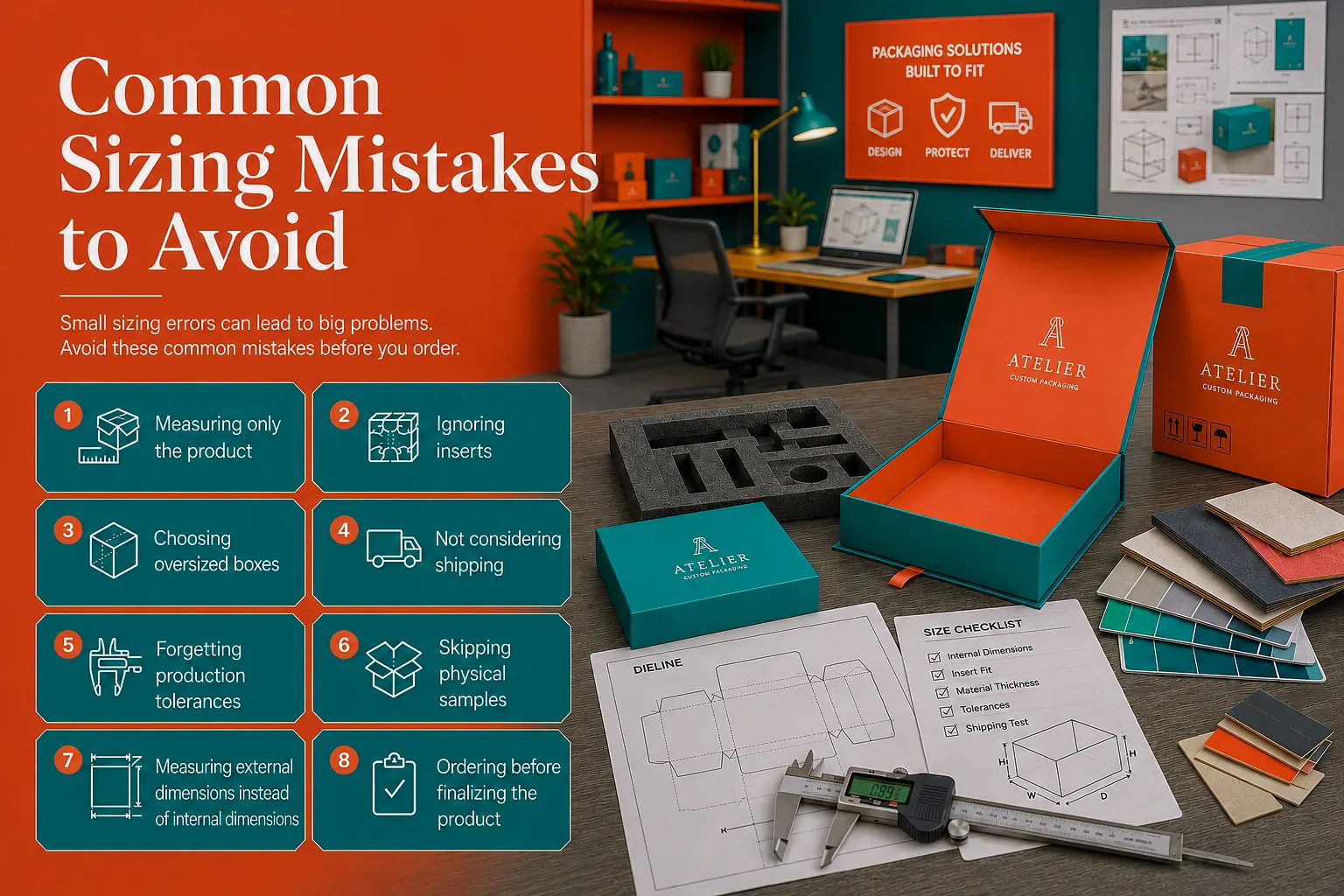
Even a professionally designed box can fail if the original measurements are inaccurate. Avoid these common mistakes:
- Measuring only the product: Always consider the complete packed configuration.
- Ignoring inserts: Dividers and trays occupy valuable internal space.
- Choosing oversized boxes: Excess space can increase material use and shipping volume.
- Not considering shipping: A retail box may need additional protection when used for e-commerce.
- Forgetting production tolerances: Manufacturing involves tolerances, so the finished box may vary slightly from theoretical dimensions.
- Skipping physical samples: A digital dieline cannot always reveal how a box will perform with the real product.
- Measuring external dimensions instead of internal dimensions: The usable space inside the box is what determines whether your product fits.
- Ordering before finalizing the product: Changes to bottles, components, or inserts can make previously approved packaging unsuitable.
Wholesale Booklet Boxes: Planning Sizes for Bulk Orders
When ordering Wholesale Booklet Boxes, sizing decisions become even more important because a small design mistake can be multiplied across hundreds or thousands of units.
Start by determining your expected sales volume and inventory requirements. Ordering too many boxes in an unsuitable size can tie up storage space and capital.
For Bulk Booklet Boxes, also consider:
- MOQ: Check the supplier’s minimum order requirements and whether your desired quantity is commercially practical.
- Inventory: Estimate how many boxes you can store without creating unnecessary warehouse pressure.
- Shipping: Consider both the packed product and the packaging shipment itself.
- Production efficiency: Repeated production of one well-tested size can be more efficient than frequently changing specifications.
- Future product changes: If a bottle, insert, or accessory is likely to change soon, avoid committing to a very large order before the final product configuration is confirmed.
A useful approach is to approve a prototype first, test the packed product, and then proceed with the larger production run.
Working with a Booklet Box Manufacturer
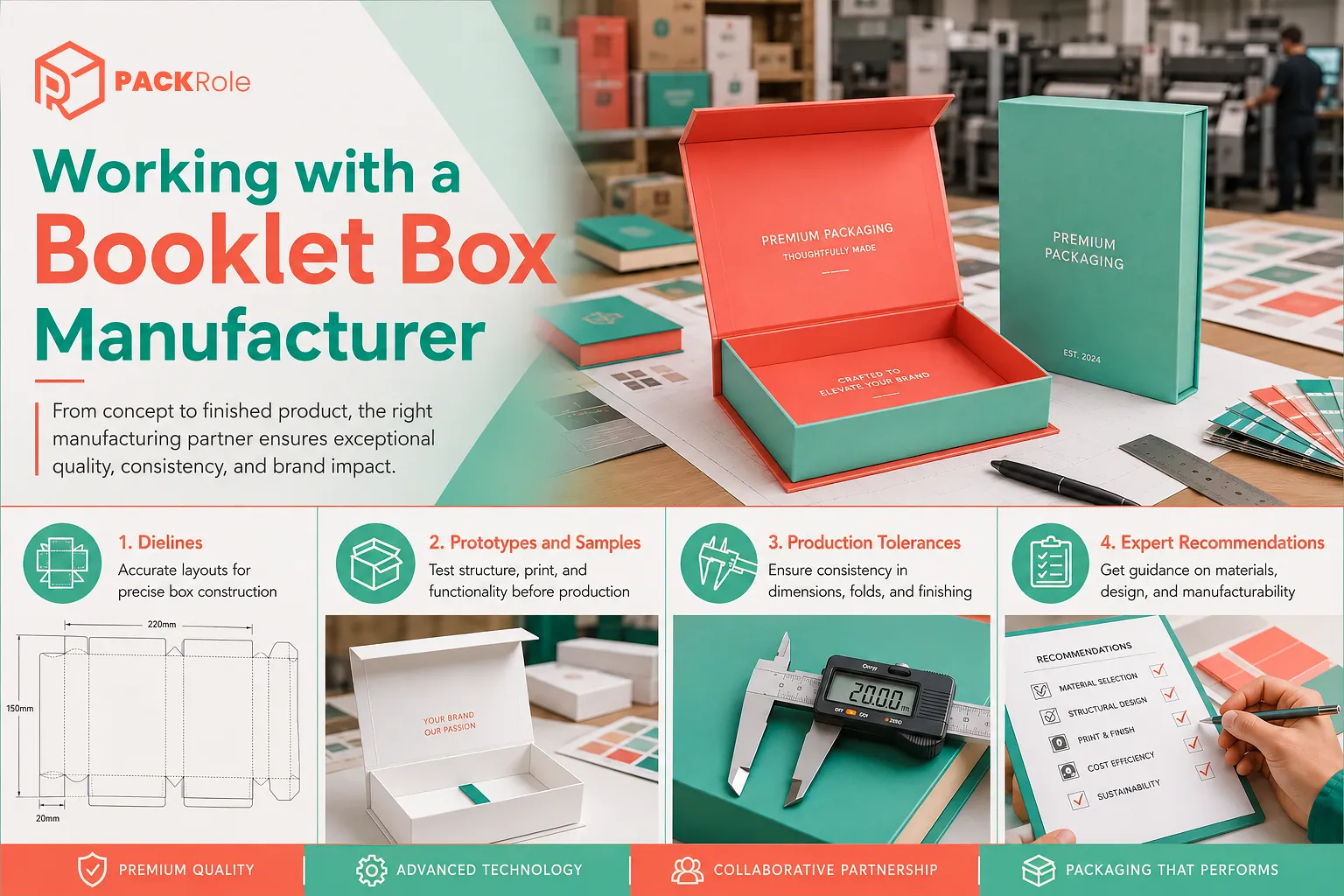
A professional Booklet Box Manufacturer can help turn product measurements into a functional packaging structure.
Start by providing accurate product measurements, product weight, intended quantity per box, insert requirements, shipping method, and desired material.
The manufacturer can then develop a dieline showing the panels, folds, flaps, and structural dimensions.
Dielines
A dieline is essentially the technical blueprint for the box. It shows where the packaging will be cut, folded, glued, and printed.
Do not begin final artwork until the structural dieline has been approved.
Prototypes and Samples
A prototype allows you to check whether the product fits correctly and whether the opening and closing mechanism works as intended.
For premium packaging, evaluate not only fit but also how the box feels in the customer’s hands.
Production Tolerances
Packaging is manufactured using physical materials and converting processes, so dimensional tolerances must be considered. Your packaging partner should confirm the appropriate specifications before mass production.
Expert Recommendations
A knowledgeable Booklet Box Supplier can often identify problems that are easy to overlook, such as insufficient clearance, excessive material use, weak panels, or inefficient shipping dimensions.
When selecting a Custom Packaging Manufacturer, look for experience with structural packaging, sampling, printing, finishing, and the material appropriate for your product.
A Practical Booklet Box Size Formula
A simple starting point is:
Required internal length = product length + necessary clearance
Required internal width = product width + necessary clearance
Required internal height = product height + insert/padding space + necessary clearance
For example, imagine a promotional box kit containing a 7-inch notebook, a pen, a small card, and a cosmetic sample. You should not simply add the measurements of each item and choose the nearest box.
Instead, arrange the products in their intended positions, determine the insert configuration, measure the complete arrangement, and then add appropriate protective clearance.
This approach produces a more useful Booklet Box Size Chart because it is based on the actual packed configuration rather than arbitrary standard sizes.
Remember that internal dimensions and external dimensions are not interchangeable. External dimensions include the material thickness and structural features, while internal dimensions describe the usable cavity available to the product.
How to Choose the Best Size for Different Products
Different product categories have different packaging priorities.
Cosmetics: Compact dimensions, bottle stability, inserts, and premium finishes are often important. A custom serum box may need individual cavities to prevent bottles from moving.
Electronics boxes : Measure the main device together with cables, adapters, manuals, and accessories. Protective inserts may significantly affect the required internal dimensions.
Luxury gifts: Presentation is often as important as protection. Rigid boxes, foil stamping, embossing, and carefully fitted inserts can create a premium unboxing experience.
Promotional boxes: These often contain multiple unrelated items. Start by deciding the internal arrangement before determining the overall box size.
The best packaging is therefore not necessarily the smallest possible box. It is the smallest practical structure that safely accommodates the complete product configuration and supports the intended customer experience.
Final Checklist Before Ordering
Before approving your packaging, confirm:
- Product length, width, and height are accurate.
- Internal dimensions have been distinguished from external dimensions.
- Inserts and protective materials have been included.
- Product weight has been considered.
- The material is appropriate for the box size and product.
- Shipping requirements have been evaluated.
- The box has been physically sampled where necessary.
- Artwork matches the approved dieline.
- Production tolerances have been discussed.
- Storage requirements have been considered.
- The final quantity matches realistic inventory needs.
If you are comparing suppliers, ask for a prototype and verify the packed dimensions before committing to a large production run.
Conclusion: Get the Right Booklet Box Dimensions Before Production
Choosing the right Booklet Box Dimensions is a balance between product fit, protection, material strength, shipping efficiency, storage, and brand presentation. The most reliable approach is to measure the complete product configuration, account for inserts and protective clearance, select a suitable material, and test a physical sample before mass production.
For businesses that need precise sizing and branded packaging, custom structures can provide a better fit than forcing products into standard formats.
Packrole is a custom packaging manufacturer specializing in custom boxes, paper tubes, mailer boxes, rigid boxes, corrugated packaging, sustainable packaging, and custom printed packaging for businesses across the United States. Its packaging solutions include customization, structural development, printing, and finishing options designed around different product and brand requirements.
Whether you need a compact cosmetic package, protective electronics box, premium luxury gift package, or multi-item promotional kit, starting with accurate measurements is the simplest way to achieve packaging that performs well from production to unboxing.